Drill Results: What Makes Them Good, Bad and Ugly
Drill Results: What Makes Them Good, Bad and Ugly
Picture this moment: It's dark outside, pre-market, 6am on the west coast in the winter. You are tired but awake and dedicated to seeing if any of the companies you invested in have announced the much anticipated drill results from their fall drilling campaigns.

Drill Results: What makes them Good, Bad and Ugly
Picture this moment: It's dark outside, pre-market, 6am on the west coast in the winter. You are tired but awake and dedicated to seeing if any of the companies you invested in have announced the much anticipated drill results from their fall drilling campaigns. You're scrolling through news and then you see it! A headline and the name of your company beside it. The buzz of excitement is intoxicating, you nervously click the link and see the news. You read the headline and the highlights and see the ‘shiny’ drill core pictures. Your hands shake and eyes twitch, but not from too much coffee. You don’t know exactly what you're looking at but it does look good. You log onto a chat board and other bleary eyed west coasters are coming to the same conclusion. It looks good, really good, amazing even. The word “bonanza” gets thrown around. Your nervous shaking hands turn to excitement, the other tab on your laptop’s browser still has that car you have always wanted and only dreamed about. You start to realize this could be it! The time you get your car and maybe even get rich! Suddenly you notice its 629am now and the market is about to open. You scramble to log into your brokerage account. By the time you do the market is open, but your stock is only up a penny. A mere few percent. How can that be? You think to yourself. Then the selling starts… Before the day is done your stock is down 20% and your dreams of cars and vacations have turned to worries about what you will say to your partner when they find out about the stock. You go back to re-read the news, now in a much different mood then the last time you looked at it. You realize you don't really understand what you're even reading. The words like “infill” and “extension” and random feet and metres, still sound good to you. It's at that time you realize you need to better educate yourself if you want to prevent this from happening again.
Many of you have been in this situation. Believing what you read on chat boards or going off misleading headlines. Of course we cannot dictate which way the market will take a stock, we can though be better prepared to understand what we are looking at. We have included below some of the key things to look for (and look out for) when reading a drill result news release.
Pictures of Drill Cores
Unless you are a geologist (and even then) pictures of drill cores are just plain misleading.You really don't know what you are looking at, no matter how shiny or metallic, it could be riches or just a valueless mineral. Do not ever base an investment decision on a drill core picture. Period.
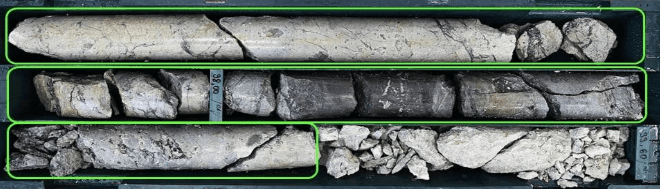
A drill core. Filled with valuable minerals (or not?)
Infill Drilling
Infill drilling is common in news releases. Infill drilling means drilling in an area where the results are pretty much expected to be at a certain grade level. It's usually used to increase the accuracy of resource estimates. For example if the company has drilled a point A and a point C and point B is right in the middle of the two points, then it is expected that the mineralization that was hit in point A and C should continue in point B. When a infill drill result is released it can be a good surprise to show even more mineralization but more than likely the market response will be muted to infill drilling unless of course the mineralization is not there and the deposit is either split into two halves or does not continue the way the company expects. Both situations would be seen as negative from a share price perspective.
Step out or Extension drilling
Step out or extension drilling is the opposite of infill drilling. The company is trying a new drill target that is a ‘step out' from past drilling. Depending on how far the step out is from previous drilling could determine the spiciness of the results. The farther the step out is away from previous drilling the bigger the deposit could be as a whole. Once a company has completed a major step out and hit mineralization, then the infill drilling to prove the resource becomes more important, especially if the step was a big distance. A step out drill hole can also be a complete miss. This could hit the stock price if investors had high hopes for an extension of a mineralized trend. A new area or target not previously drilled is known as a greenfield target and not to be confused with step out drilling.
Depth
Depth for drill results is key. Depth starts at ‘surface’ and goes down from there. ‘Near-surface’ is a term that is overused in the industry. Near-surface may not actually be near the surface at all, so always look at the actual depth numbers. Remember deposits closer to the surface are the ones that would be the likely candidates for open pit mining which is usually the cheapest way to recover minerals. A company could intersect a great seam of gold but if it's hundreds of metres deep without the potential for underground mining it could be unattainable and therefore worthless.
Grade and Length
Grade is a key indicator to the success of a drill program. When companies release grades they usually highlight the best grades in a table or even in the headline of the news release itself. These headlines can be misleading without knowing depth, or if it's an infill or step out drill. Companies will emphasize the best portion of a drill core in the news release. For example a core result could say 30 (grams/tonne) Au (gold) over 1 metre from 200M to 201M. An investor could think this is an amazing result of 30 grams a tonne but the reality is the gold in this drill core is deep and only over one metre which isn't the best result. Now if this company reported that the 30 grams/tonne was over 50 metres from 3M to 53M in depth then you have a much better result with gold extending from near the surface down 50 metres and with an excellent grade. Potentially the makings of a mine. From there the company would step out in all directions to see if the deposit continues. The last indicator commonly seen in a drill result is the Au or Ag Equivalent indicator (final column in the table below). This column of a drill result combines the value of multiple minerals into the gold or silver value. It can be a useful tool to show the value of a drill hole but do remember that companies are usually targeting specific minerals and too much lower grade other minerals may raise the equivalent number but provide little real economic value.
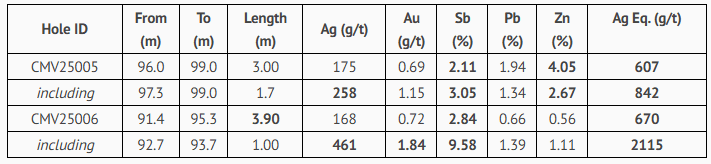
Example drill results table from a news release
Cross Sections
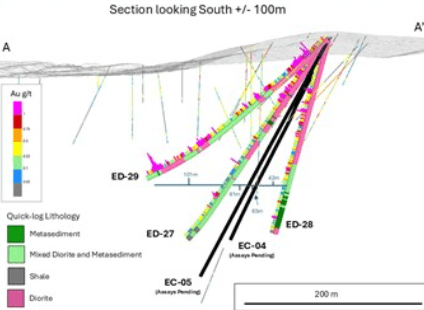
Cross sections are two dimensional slices of a map that can help companies and investors understand the shape, size and depth of a deposit. The more drill holes added to the map the clearer the picture of the deposit becomes. These cross section maps can be a powerful tool for investors to help understand the future mining potential of the deposit. Cross sections help regular investors understand the deposit in a simple diagram that normally would only be understood by a geologist. The company can also use these cross sections to better select future drilling options and therefore save money defining the deposit. Cross sections do not appear in all new releases but when they do they can really add to the excitement and understanding of results.
Comments from Management
Comments from management need to be taken with a grain of salt. Management is in the business of attracting investors. When drills miss mineralization they will highlight the other potential results to come or the reasons why this drill core was a duster. That being said there are valuable management comments which can indicate how the results are interpreted to the company and the plan going forward.
Conclusion: Why it all matters?
If you skipped the rest of this article and want to know why it all matters then you have come to the right place. As an investor you need to know some of the technical jargon and basics of drill results to help make informed investment decisions. Interpreting the drill results grade, depth, type of drilling and management comments will help you as an investor and keep you from falling for the nasty surprise of ugly drill results that sound ‘good’. The more you know the better your chances of making money, the real reason we are all investors.
Disclaimer: This newsletter is for informational purposes only and does not constitute financial advice. Investing in junior mining companies involves significant risk.